


Quick Answer
Nurse foot pain after 12-hour shifts can develop because the feet and lower legs spend long periods supporting body weight while standing, walking, turning, and responding to changing clinical demands.
Prolonged workplace standing can contribute to physical fatigue, muscle pain, leg swelling, tiredness, and general discomfort. Prolonged-standing environments can also increase the risk of foot and ankle problems among nurses.
A suitable nursing shoe may make a long shift more manageable, but no shoe can remove every possible cause of pain. Fit, cushioning, stability, traction, workload, previous injuries, and individual health conditions can all affect comfort.
Affiliate Disclosure: StandingSole may earn a commission from qualifying purchases made through links on this page, at no extra cost to you. This does not affect our editorial guidance.
Why Can 12-Hour Nursing Shifts Make Feet Hurt?
A nursing shift does not involve one simple movement.
A nurse may stand during a procedure, walk between rooms, turn quickly, push equipment, climb stairs, or remain near a workstation for an extended period. The feet and lower legs repeatedly support and stabilize the body through these changing tasks.
Two demands are especially relevant.
Prolonged Standing
Remaining upright for long periods can contribute to muscle fatigue, lower-limb swelling, and general discomfort.
Prolonged standing can contribute to physical fatigue, muscle pain, leg swelling, tiredness, and general body discomfort. Moving periodically and changing posture may be more comfortable than remaining in one fixed position.
Repeated Walking and Direction Changes
Walking through a clinical environment repeatedly loads and unloads the feet.
Turning, stopping, and changing direction also require the feet and ankles to control movement. A shoe that slips, feels unstable, or does not match the wearer’s foot shape may make these movements less comfortable.
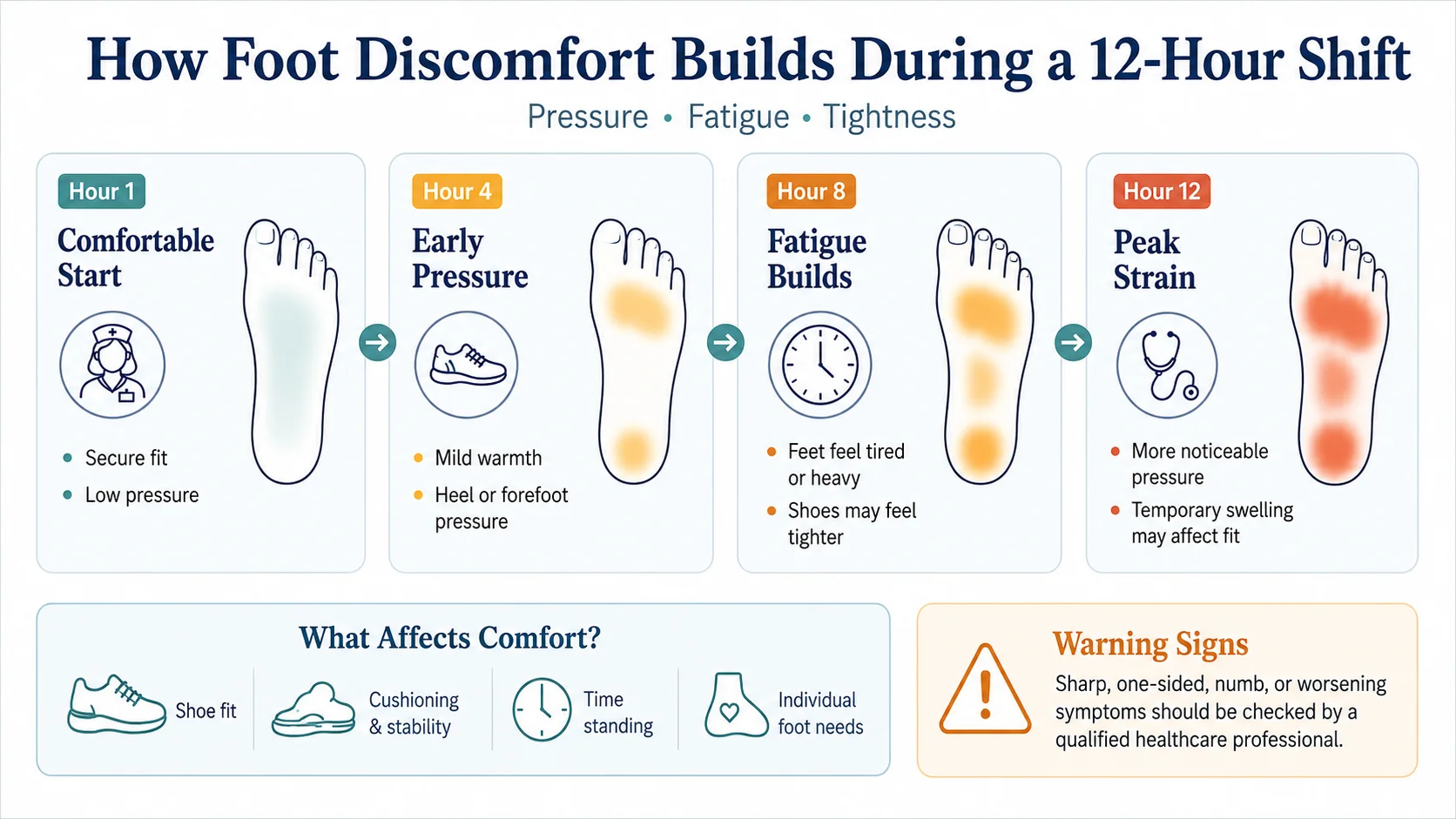
For many nurses, discomfort builds gradually rather than appearing as one sudden event.
What Foot Discomfort Patterns May Appear After a Long Shift?
Foot discomfort can appear in different places and feel different from one person to another.
These descriptions can help you explain your symptoms, but they should not be used to diagnose their cause.
General Foot Fatigue
This may feel like aching, heaviness, warmth, burning, or broad soreness across the bottom of the foot.
Foot and ankle pain is commonly reported among nurses who work in prolonged-standing environments. Numbness and burning sensations have also been reported, although symptoms and individual experiences can vary.
Heel Discomfort
Heel discomfort may appear during or after a shift.
A sharp sensation during the first steps after waking can occur with plantar fasciitis, although several other conditions may produce similar symptoms. Plantar-fasciitis pain is often worse during the first steps in the morning and may return after prolonged standing.
Forefoot Pressure
The area beneath the ball of the foot may become uncomfortable after extensive standing or walking.
A shoe that is too short, narrow, or shallow may also create unwanted pressure and friction around the front of the foot.
Arch Discomfort
Some nurses notice tiredness or pressure around the arch. This does not automatically mean that a firmer insole is needed.
Shoe shape, fit, support preference, movement pattern, workload, and existing health conditions can all affect how the arch feels.
Lower-Leg or Foot Swelling
Shoes that feel comfortable at the beginning of a shift may feel tighter later.
Prolonged standing can contribute to occupational lower-leg swelling, but persistent, painful, severe, or one-sided swelling should not be dismissed as normal shift fatigue.
How Do Hard Hospital Floors Affect Comfort?
Healthcare floors need to be durable and easy to maintain. These surfaces may feel firm and unforgiving during prolonged standing and walking.
Extended standing can place stress on the legs and back. Helpful workplace measures may include posture changes, resilient mats, stools, footrests, and cushioned footwear where appropriate. Footwear designed for prolonged standing and walking may also make hard surfaces feel more manageable.
That does not mean the softest shoe is automatically the best choice.
A very soft shoe may feel comfortable during a brief try-on but less stable during turning or prolonged standing. Cushioning should be considered together with:
- Heel security
- Midfoot structure
- Outsole width
- Overall fit
- Forefoot flexibility
- Traction
- Workplace requirements

What Can Nursing Shoes Actually Do?
Footwear is only one part of long-shift comfort.
Nursing Shoes May Help By:
- Providing cushioning between the foot and a firm floor
- Holding the heel more securely
- Giving the toes enough room
- Providing a stable base for standing and walking
- Reducing rubbing and unwanted movement
- Providing traction suited to the workplace
- Accommodating a suitable insole or prescribed orthotic
Nursing Shoes Cannot:
- Diagnose the cause of foot pain
- Treat every heel, arch, nerve, or circulation problem
- Guarantee pain-free 12-hour shifts
- Prevent every slip or injury
- Correct a serious medical condition
- Compensate fully for poor fit
- Replace professional assessment when symptoms persist
Judge a shoe by how it fits and functions for you, not by marketing terms alone.
What Should Nurses Check Before Buying Shoes for Long Shifts?
Use this checklist when comparing nursing shoes.

| Feature | What to Check | Why It Matters |
|---|---|---|
| Length | Leave comfortable room ahead of the longest toe | Helps prevent repeated contact with the front |
| Width | Check for pressure, bulging, or numbness | A longer size does not always solve a width problem |
| Toe box | Toes should lie naturally without being pinched | Reduces crowding and friction |
| Heel hold | The heel should not repeatedly lift or slide | Helps control movement inside the shoe |
| Midfoot structure | The shoe should not collapse or twist excessively | May improve stability for some wearers |
| Forefoot flex | The shoe should bend near the toe joints | Allows movement where the foot naturally bends |
| Cushioning | Look for comfort without a sinking or unstable feel | May make firm floors feel less harsh |
| Outsole base | Check whether the platform feels secure during turns | A narrow or unstable base may not suit every wearer |
| Traction | Review tread and verified manufacturer information | Important on smooth workplace floors |
| Closure | Adjustable closures allow the fit to be refined | Useful when foot volume changes |
| Upper | Consider cleanability, breathability, and fluid exposure | Workplace needs vary |
| Removable insole | Check whether removal changes the fit | Useful if an approved insert is needed |
| Policy compliance | Confirm color, material, heel, and sole rules | Employer and program requirements vary |
Choose shoes that match the natural shape of the foot. Check where the shoe bends, whether the heel counter provides control, and whether the toe area offers adequate room.
Wide Toe Box vs. True Wide Width
A wide toe box and a wide-width shoe are not necessarily the same.
A wide toe box mainly provides more room around the toes. A true wide width provides additional room across more of the shoe, potentially including the forefoot and midfoot.
Nurses who feel pressure across the sides or ball of the foot, not only around the toes, may need a true wide-width option rather than a standard-width shoe with a rounded front.
Read StandingSole’s complete guide to nursing shoes for wide feet.
How May Arch Support Affect Comfort?
There is no single arch-support level that works for every nurse.
The appropriate amount depends on:
- Foot shape
- Shoe shape
- Personal comfort
- Walking pattern
- Existing symptoms
- Whether an orthotic has been prescribed
- The amount of space inside the shoe
A suitable insole may help some people feel more stable or distribute pressure more comfortably. However, an arch that presses painfully into the foot, causes numbness, or changes the way you walk is not automatically beneficial.
Supportive shoes, cushioning, and orthotics may be considered for plantar-fasciitis-related pain. However, this does not mean that every nurse requires firm arch support or an orthotic.
Persistent heel or arch pain should be assessed rather than managed only by buying progressively firmer inserts.
How Can Nurses Manage End-of-Shift Swelling Safely?
Mild temporary fullness in both feet or lower legs can occur after prolonged standing.
Several practical measures may feel helpful.
Change Position When Possible
Brief walking, shifting weight, sitting, or moving the ankles may be preferable to remaining completely still.
Movement and opportunities to change posture may be more comfortable than remaining completely still for long periods.
Avoid an Excessively Tight Shoe
A shoe should remain comfortable as the shift progresses.
However, buying a shoe that is too loose may create heel slipping, friction, and reduced stability.
Elevate the Legs During Recovery
Comfortable elevation after work may help some people manage temporary heaviness or mild swelling.
Consider Compression Socks Carefully
Compression stockings may reduce occupational lower-leg swelling or related discomfort for some people who work in prolonged-standing positions. However, suitability varies, so compression should not be treated as a universal solution.
Ask a qualified healthcare professional about compression suitability when you have:
- Known circulation problems
- Peripheral arterial disease
- Diabetes-related foot concerns
- Reduced sensation
- Significant or unexplained swelling
- Skin wounds
- A history of blood clots
- Another condition affecting the legs or circulation
How Can You Tell When Nursing Shoes Are Wearing Out?
There is no universal rule stating that every nursing shoe must be replaced after a fixed number of months or miles.
Wear depends on:
- Shift frequency
- Walking distance
- Body weight and movement pattern
- Floor surface
- Shoe materials
- Moisture and cleaning exposure
- Whether more than one pair is used
Inspect your shoes for the following signs.
Worn Outsole Tread
A smooth or heavily worn outsole may provide less dependable contact with the floor.
Uneven Wear
One side of the outsole or heel may wear faster than the other.
Some uneven wear is common, but a shoe that sits noticeably unevenly or affects the way you walk deserves closer inspection.
Distorted Shape
Place the shoe on a level surface.
A visibly leaning, compressed, or misshapen shoe may no longer provide its original fit or stability.
Reduced Heel Hold
The heel may begin slipping because the upper has stretched, the heel counter has softened, or the shoe did not fit securely from the beginning.
New Rubbing or Pressure
A worn lining, compressed insole, or changed upper can create new friction points.
Reduced Comfort
A shoe that once felt comfortable may begin to feel flat, harsh, or unstable.
Excessive Midfoot Bending
Shoes should generally bend around the forefoot rather than folding easily through the arch or shank. This is only one part of assessing a shoe and should not be treated as a complete pass-or-fail test.
Consider replacing work shoes when traction, fit, heel hold, cushioning, or structural condition has clearly declined.
What Simple Recovery Habits May Help After a Shift?
Recovery should be gentle and should not increase pain.
Rest and Elevate
Resting with the feet comfortably raised may help temporary heaviness or mild swelling.
Move the Ankles
Gentle ankle pumps or circles provide movement after remaining upright for long periods.
Stretch the Calves Gently
A controlled calf stretch may feel useful when the lower legs feel tight.
Do not bounce or force the stretch.
Use Cold Carefully
A cloth-covered cold pack may feel soothing for localized soreness.
Cold rolling with a bottle is sometimes included in plantar-fasciitis self-care guidance, but it should not be treated as a universal remedy for every type of foot pain.
Inspect the Feet
Check for:
- Redness
- Blisters
- Cuts
- Pressure marks
- Swelling
- Skin changes
- Nail problems
Foot inspection is particularly important for people with diabetes, neuropathy, or reduced sensation.
Stop any exercise or recovery method that increases pain, numbness, tingling, dizziness, or weakness.
What Footwear Mistakes Should Nurses Avoid?
Buying According to Brand Reputation Alone
A well-known brand can still make a shoe that does not match your foot.
Expecting a Tight Shoe to Break In
Do not rely on a painful shoe eventually becoming comfortable.
Choose shoes that fit comfortably at the time of purchase rather than expecting the feet to stretch the shoes over time.
Moving Up a Size Instead of Changing Width
A longer shoe may create sliding without providing the width you need.
Choosing Softness Without Checking Stability
Soft cushioning may feel pleasant during a brief try-on but unstable during a long shift.
Ignoring Heel Fit
A roomy toe box does not compensate for a heel that repeatedly lifts or slides.
Depending on One Bend or Twist Test
Manual shoe tests provide limited information.
The full decision should include fit, comfort, outsole condition, heel hold, forefoot movement, and workplace demands.
Wearing Shoes After Traction Has Deteriorated
A clean upper does not prove that the outsole and midsole remain in suitable condition.
Assuming Every Running Shoe Is Suitable or Unsuitable
Some running shoes may work in healthcare settings, while others may not.
Judge the individual shoe by its:
- Fit
- Stability
- Upper material
- Traction
- Cleanability
- Workplace compliance
Ignoring Workplace or School Rules
Healthcare facilities and nursing programs may have different footwear requirements.
Check the current policy before buying, especially when color, heel coverage, upper material, or sole type is regulated.
When Does Foot Pain Need Medical Attention?
Mild fatigue may settle after rest. Recurring, worsening, or highly localized pain should not automatically be dismissed as part of nursing.
Arrange a medical assessment when:
- Pain interferes with work or normal activities
- Pain is getting worse
- Pain repeatedly returns
- Symptoms do not improve with reasonable self-care
- You experience numbness, tingling, burning, or reduced sensation
- The foot feels weak or unstable
- Pain changes the way you walk
- Morning heel pain keeps returning
- Swelling is persistent, severe, painful, or one-sided
- You have diabetes and develop new foot pain or skin changes
Medical assessment is appropriate when foot pain limits normal activities, worsens, repeatedly returns, or occurs with tingling, weakness, or loss of sensation.
Seek urgent medical attention when:
- You cannot walk after an injury
- The foot appears deformed
- You heard a snap, grinding, or popping sound during an injury
- You have severe pain
- You have an open wound or signs of infection
- One leg becomes suddenly painful and swollen
- Leg symptoms occur with chest pain or breathing difficulty
Frequently Asked Questions
Why Do Nurses’ Feet Hurt After 12-Hour Shifts?
Prolonged standing, repeated walking, hard floors, limited recovery opportunities, footwear fit, individual foot shape, and existing health conditions may all contribute.
The shoe is not always the only cause, although unsuitable or worn footwear may make discomfort worse.
What Type of Nursing Shoe Is Best for Foot Pain?
There is no universally best nursing shoe.
Look for a shoe that matches your foot shape, holds the heel securely, provides comfortable cushioning, feels stable, gives the toes enough room, and complies with your workplace requirements.
Persistent pain requires professional assessment rather than relying only on a shoe change.
Is More Cushioning Always Better for Nurses?
No.
Cushioning may make firm surfaces feel more comfortable, but extremely soft or unstable cushioning may not suit every wearer. Assess the shoe while standing, walking, turning, and stopping.
Is Firm Arch Support Better for a 12-Hour Shift?
Not necessarily.
The right support should feel comfortable and stable without pressing painfully into the arch or changing the way you walk.
Can Nurses Wear Running Shoes at Work?
Sometimes.
Suitability depends on the individual shoe’s fit, traction, upper material, stability, cleanability, and workplace policy.
Do Compression Socks Help Nurses?
Properly fitted compression socks may help some people manage occupational lower-leg swelling or heaviness.
They do not address every cause of foot pain and may not be suitable for people with certain circulation, skin, nerve, or medical conditions.
How Often Should Nursing Shoes Be Replaced?
There is no universal replacement schedule.
Inspect the outsole, heel structure, fit, cushioning, and overall shape. Consider replacement when wear affects traction, comfort, heel hold, or stability.
Why Do Shoes Feel Tighter Near the End of a Shift?
Prolonged standing may contribute to temporary foot or lower-leg fullness.
Sock thickness, temperature, shoe volume, and fit may also affect how the shoe feels. Severe, sudden, painful, persistent, or one-sided swelling should be assessed medically.
Final Takeaway
Nurse foot pain after 12-hour shifts usually involves more than one factor.
Prolonged standing, repeated walking, firm floors, limited posture changes, individual foot shape, existing health conditions, and footwear condition may all affect comfort.
When choosing nursing shoes for long shifts, focus on:
- Correct length and width
- Adequate toe room
- Secure heel hold
- Comfortable, but not excessive, cushioning
- Appropriate midfoot stability
- Suitable workplace traction
- Policy compliance
- Comfort that lasts beyond a brief try-on
Footwear may support comfort, but it cannot diagnose or treat persistent pain.
Recurring, worsening, sharp, one-sided, or sensation-related symptoms deserve professional evaluation.
Sources Consulted
This article was prepared using government occupational guidance, orthopedic information, public medical guidance, and peer-reviewed research.
CDC/NIOSH: Prolonged Standing at Work
Supports the discussion of physical fatigue, muscle pain, leg swelling, tiredness, discomfort, and posture changes associated with prolonged workplace standing.
Read the CDC/NIOSH guidance (CDC)
Bernardes et al.: Foot and Ankle Disorders in Nurses Exposed to Prolonged Standing Environments
A peer-reviewed nurse-specific scoping review covering foot and ankle disorders and symptoms associated with prolonged-standing work.
Read the study on PubMed (PubMed)
OSHA: Work-Related Musculoskeletal Disorders in Hospitals
Supports the discussion of measures for prolonged standing and walking on hard surfaces.
Read the OSHA hospital guidance (OSHA)
OSHA: Lower-Extremity Ergonomic Solutions
Supports the discussion of hard surfaces, posture changes, anti-fatigue mats, footrests, and cushioned footwear.
Read the OSHA ergonomic guidance (OSHA)
American Academy of Orthopaedic Surgeons: Shoes: Finding the Right Fit
Supports the discussion of shoe shape, toe room, sizing, and appropriate fit.
Read the AAOS shoe-fit guide (OrthoInfo)
American Academy of Orthopaedic Surgeons: Tight Shoes and Foot Problems
Supports the discussion of toe-box room, shoe structure, heel control, and pressure caused by unsuitable fit.
Read the AAOS guidance (OrthoInfo)
Mayo Clinic: Plantar Fasciitis: Symptoms and Causes
Supports the limited discussion of first-step morning heel pain and discomfort that may return after prolonged standing.
Read the Mayo Clinic guidance (Mayo Clinic)
Guedes et al.: Occupational Leg Edema and Compression Stockings
Reviews evidence concerning prolonged standing, occupational lower-leg swelling, and compression stockings.
Read the study through PubMed Central (PMC)
NHS: Pulmonary Embolism and Blood-Clot Warning Signs
Supports the urgent warning concerning one-sided leg pain or swelling with sudden breathing difficulty or chest pain.