

Affiliate disclosure: This article may contain affiliate links. If you buy through a link, StandingSole may earn a commission at no extra cost to you. This does not affect the information we include.
If your program says you need nursing student white closed-toe clinical shoes, the rule can sound simple until you start shopping.
You may see white sneakers, leather shoes, clogs, slip-ons, mesh shoes, shoes with large logos, and shoes labeled “nursing” that still may not match your school’s policy.
The safest first step is not choosing a brand. It is checking whether the shoe matches your program’s exact requirements for color, toe coverage, heel coverage, material, sole type, and heel height.
Nursing Student White Closed-Toe Clinical Shoes: Quick Requirements
Reviewed nursing program policies show that clinical shoe rules often focus on foot coverage, material, sole type, color, and professional appearance.
Before buying, check whether your program requires:
- Closed toe
- Closed heel
- White or approved neutral color
- Low or flat heel
- Slip-resistant or non-skid sole
- Easy-clean material, such as leather, vinyl, or synthetic leather
- Non-mesh upper if your policy says non-mesh
- Non-marking or quiet sole if your policy mentions it
What Do White Closed-Toe Clinical Shoes Usually Mean?
A white closed-toe clinical shoe rule is usually about more than color.
White shoes
White shoes means your program expects white footwear if the policy specifically says white. Do not assume gray, black, navy, tan, or brown is allowed unless your program says neutral colors are acceptable.
Closed toe
Closed toe means the front of your foot is covered. Avoid sandals, peep-toe shoes, and shoes with open areas at the front.
Closed heel
Closed heel means the back of your heel is covered. Open-back clogs, open-heeled shoes, and backless styles can fail a closed-heel rule.
Low heel or flat sole
Low heel or flat sole means avoiding high heels, wedges, platforms, and chunky fashion soles if your program requires flat or low-heeled footwear.
Slip-resistant or non-skid sole
Slip-resistant or non-skid sole means the product listing should clearly mention slip-resistant, non-skid, or work-shoe traction. No shoe guarantees traction in every situation.
Easy-clean material
Easy-clean material means checking for leather, vinyl, synthetic leather, or another material your program approves. If your policy says non-mesh, avoid mesh, knit, canvas, and fabric uppers.
Why Do Nursing Programs Set Clinical Shoe Rules?

Clinical shoe rules are practical.
A closed toe and closed heel help keep the foot covered in patient-care areas. Easy-clean materials are often preferred because they can be wiped down more easily than fabric or mesh. Slip-resistant or non-skid soles are commonly listed in clinical footwear policies.
Professional appearance also matters. Nursing students represent their school and clinical site, so programs may set rules around shoe color, shoe condition, and overall appearance.
A shoe can look like a nursing shoe and still fail your program’s dress code. Always check the actual policy.
Clinical Shoe Dress Code Decoder
Use this table to turn policy wording into shopping checks.
| Policy term | What it means when shopping | What to avoid |
|---|---|---|
| Closed toe | The front of the foot is fully covered | Sandals, peep-toe shoes, open toe boxes |
| Closed heel | The back of the heel is covered | Open-back clogs, open-heeled shoes, backless styles |
| White shoes | Choose white if your program says white | Colored panels unless approved |
| Approved neutral color | Some policies allow colors like gray, black, navy, tan, or brown | Assuming neutral colors are allowed without checking |
| Leather / vinyl / easy-clean | Look for the material your program names | Mesh, knit, canvas, or fabric if your policy bans them |
| Non-mesh | Choose a solid upper material | Mesh toe boxes or knit uppers |
| Slip-resistant / non-skid | Product listing should state the sole type | Smooth fashion soles |
| Low heel / flat | Stable, low-profile footwear | High heels, wedges, platform soles, chunky soles |
| Non-marking / quiet sole | Sole should meet the wording in your policy | Soles that visibly scuff or make noise |
| Logo or branding rule | Only applies if your handbook mentions it | Large visible branding if your policy restricts it |
Quick Examples: Safer, Risky, or Ask First
These examples are not product recommendations. They are only decision examples based on reviewed policy patterns.
| Shoe situation | Likely status | Why |
|---|---|---|
| White leather or vinyl shoe with closed toe, closed heel, low heel, and slip-resistant sole | Safer candidate | Matches several reviewed policy requirements |
| White running shoe with mesh toe box | Risky if your policy says non-mesh | Some policies specifically require leather/vinyl or non-mesh footwear |
| White clog with open back | Risky if your policy requires closed heel | Closed-heel policies may not allow open-back styles |
| Black or gray closed shoe | Ask first | Some policies allow neutral colors, but others require white |
| White fashion sneaker with smooth sole | Risky | It may not meet slip-resistant or non-skid wording |
| Shoe with large visible branding | Ask first only if your policy mentions logos | Logo rules were not consistently verified in official sources |
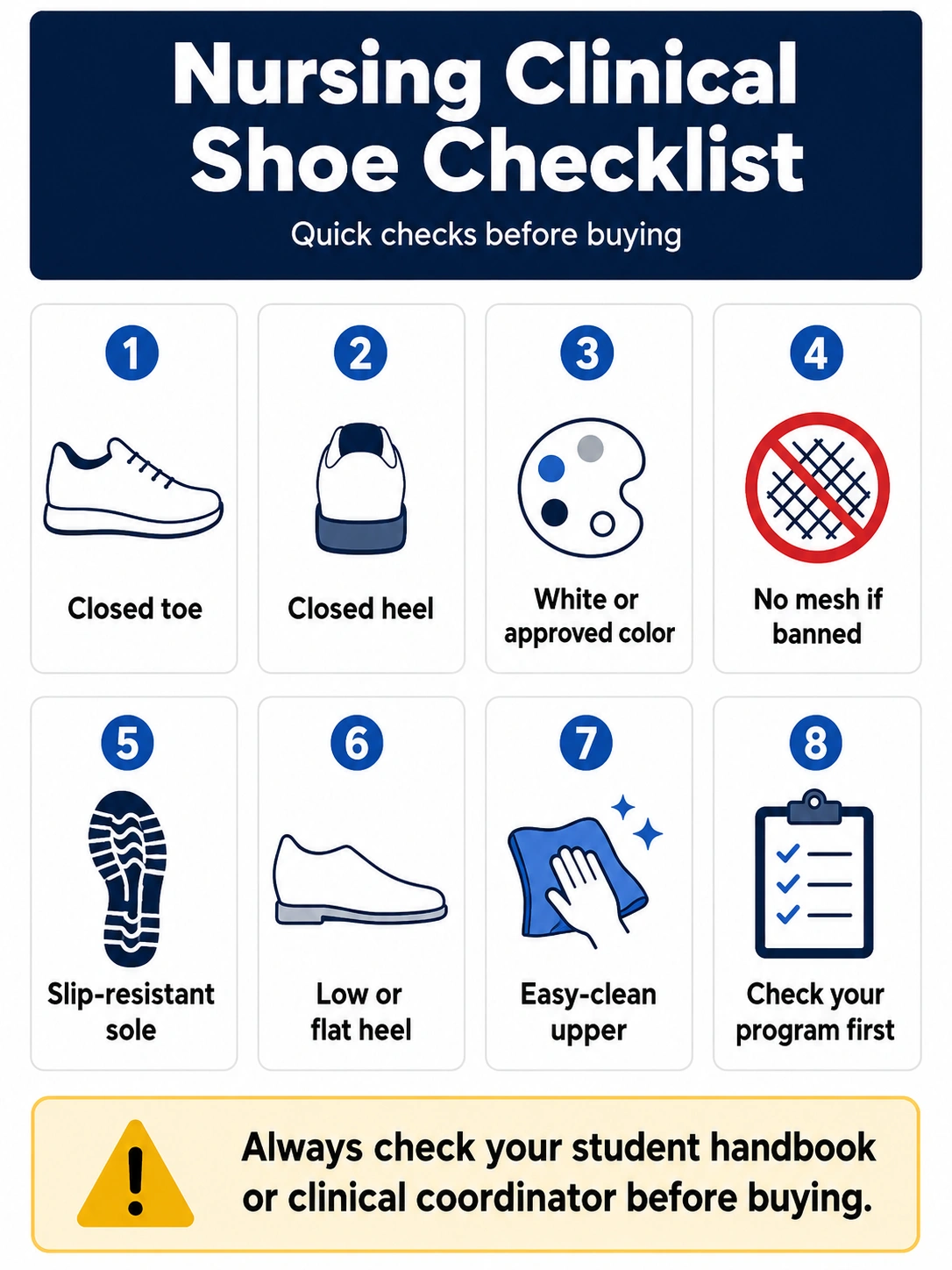
Buying Checklist Before You Purchase
Before buying any white shoes for nursing students clinicals, use this checklist.
- The toe is fully closed.
- The heel is fully closed.
- The color matches your program’s rule.
- The upper material matches your program’s wording.
- The shoe is non-mesh if your policy requires non-mesh.
- The sole is labeled slip-resistant or non-skid if required.
- The shoe is flat or low-heeled if your policy requires it.
- The sole is not chunky, platform-style, or high-heeled.
- The outsole is non-marking or quiet-soled if your program requires it.
- The shoe looks clean and professional.
- Any logo or branding is allowed by your program, if your handbook mentions branding.
- The product description confirms the material and sole type.
Price does not prove compliance. A shoe should be checked against the dress code first, then comfort and budget can be considered.
Comfort Considerations for Clinical Shifts
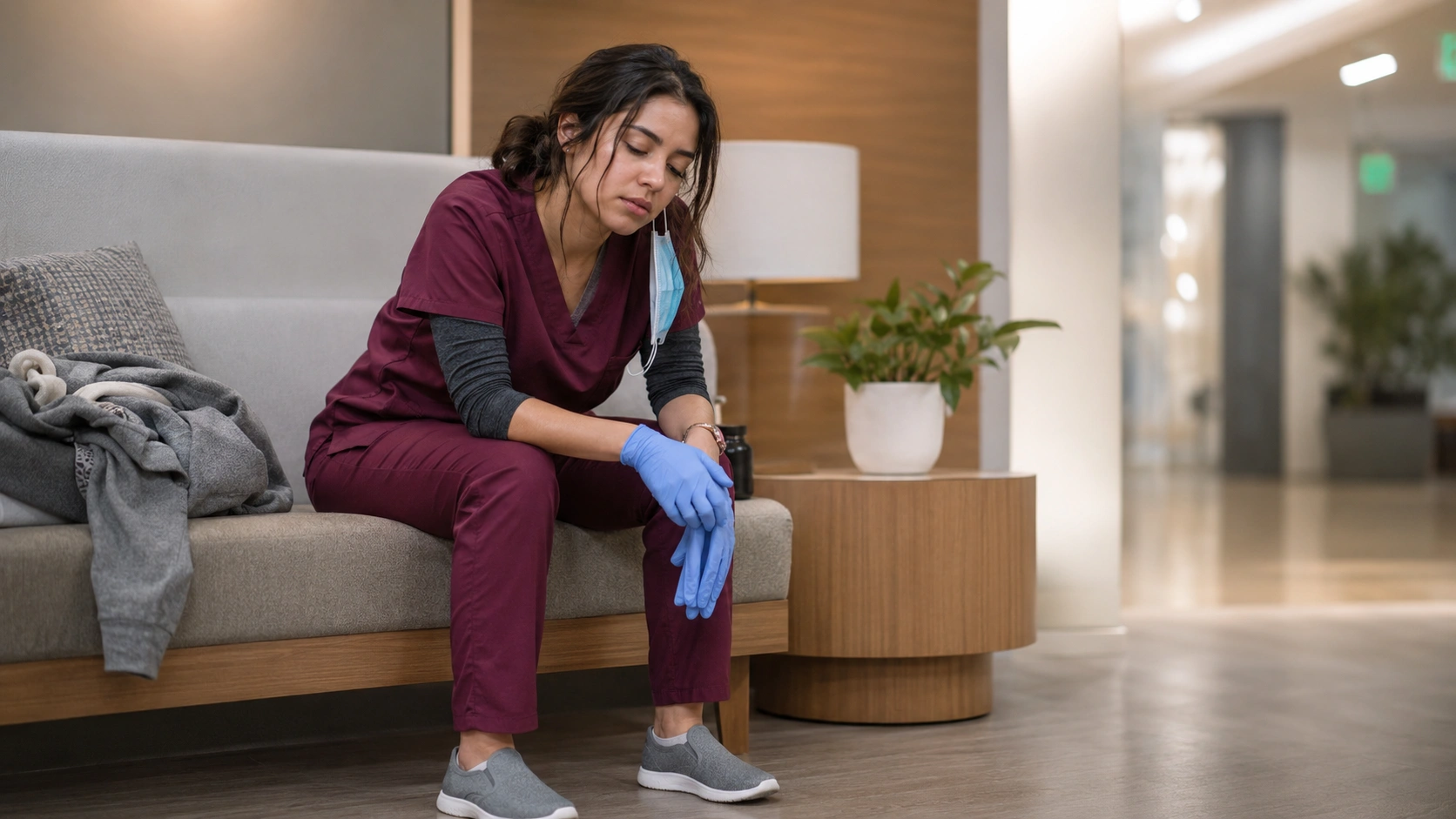
After the shoe passes the dress-code check, consider fit and comfort.
The shoe should feel secure at the heel. Your heel should not slide with each step.
The front of the shoe should not squeeze your toes. If standard widths feel tight, check whether the shoe comes in wide sizing.
Some students prefer more cushioning, while others prefer a firmer shoe. Individual comfort varies, so do not choose a shoe only because it is marketed as a nursing shoe.
Avoid making medical decisions based only on shoe marketing. Comfort features are not medical treatment.
Common Mistakes to Avoid
A shoe can look acceptable online but still fail your clinical dress code.
- Buying white mesh sneakers when your policy requires leather, vinyl, or non-mesh material.
- Choosing open-back clogs when your policy requires a closed heel.
- Assuming any light-colored shoe counts as white.
- Buying fashion sneakers without checking the sole type.
- Choosing a shoe only because it says “nursing” in the product name.
- Checking comfort first and dress code second.
- Assuming another student’s approved shoe will be approved for your course or placement.
The safer order is: check the policy, check the product details, then check comfort.
When to Get Help

Footwear can affect comfort, but footwear is not medical care.
If you have persistent foot pain, worsening heel pain, numbness, circulation concerns, diabetes-related foot concerns, or another medical condition affecting your feet, speak with a qualified healthcare professional.
Do this before relying on arch support, insoles, compression products, or footwear changes to manage symptoms.
What Should You Verify With Your Program Before Buying?
Before you purchase clinical shoes, check your student handbook, clinical orientation materials, course syllabus, or nursing department guidance.
If the wording is unclear, ask your clinical coordinator.
- Does the shoe need to be white?
- Are neutral colors allowed?
- Does the heel need to be fully closed?
- Are open-back clogs allowed or banned?
- Is mesh banned?
- Does the shoe need to be leather, vinyl, or another specific material?
- Does the shoe need to be slip-resistant or non-skid?
- Is a non-marking or quiet sole required?
- Are there rules about logos or visible branding?
- Are there different rules for different clinical placements?
A short policy check before buying can save you from returning shoes later.
Frequently Asked Questions
Are clogs allowed in nursing clinicals?
It depends on your program. If your policy requires a closed heel or says open-heeled shoes are not acceptable, open-back clogs are risky. Choose a fully closed heel unless your program clearly allows clogs.
Can nursing students wear mesh shoes in clinicals?
It depends on the policy. If your program requires leather, vinyl, impervious material, or non-mesh shoes, avoid mesh sneakers.
Do clinical shoes need to be slip-resistant?
Some reviewed policies require slip-resistant or non-skid soles. Check your program’s exact wording and confirm the product listing before buying.
What if my program allows colors other than white?
Follow your program’s wording. Some policies allow neutral colors such as gray, black, navy, tan, or brown. If your program says white, choose white unless you receive clarification.
Do nursing clinical shoes need to be logo-free?
Only treat this as a rule if your handbook or clinical coordinator says so. Logo rules were not strongly verified across the official sources reviewed for this article.
What materials should I check first?
Check the material your program names. If the policy mentions leather, vinyl, impervious material, or non-mesh shoes, avoid fabric, knit, canvas, or mesh uppers.
Sources Consulted
This guide was prepared by reviewing official nursing program, university, workplace safety, and healthcare uniform guidance sources from the United States, Canada, and the United Kingdom.
- OHSU School of Nursing — Uniform and Dress Code Requirements
- University of Maine School of Nursing — Clinicals
- OSHA — Foot Protection Standard
- University of Calgary Faculty of Nursing — Nursing Uniforms
- Lakehead University — School of Nursing Uniform Information
- Conestoga College — Health and Life Sciences Uniform Standards
- Canadian Centre for Occupational Health and Safety — Safety Footwear
- NHS England — Uniforms and Workwear Guidance for NHS Employers
- Canterbury Christ Church University — Placement Uniform Guidance
- RDaSH NHS Foundation Trust — Uniform and Appearance at Work / Dress Code Policy
- NHS Fife — Staff Dress and Uniform Policy
- Queen’s University Belfast — Nursing Placement Checklist
- National Infection Prevention and Control Manual Scotland — PPE Footwear Literature Review
- PubMed Central — Foot Health in Nursing Students Study
- CDC Stacks — Workplace Safety / Footwear-Related Reference
Program requirements can change by school, course, placement, and country. Always verify footwear rules directly with your nursing program, clinical coordinator, or placement provider before buying clinical shoes.
Final Takeaway
If your nursing program requires white closed-toe clinical shoes, do not shop by color alone.
Check the full requirement: toe coverage, heel coverage, approved color, material, sole type, heel height, and any program-specific appearance rules.
The safest buying process is simple:
- Read your handbook.
- Decode the footwear rule.
- Check the shoe details.
- Ask your clinical coordinator about anything unclear.
- Then compare comfort, fit, and price.